VMware After Broadcom
Three years after Broadcom bought VMware: what changed for licensing and home labs, why 90% of surveyed customers are looking at alternatives, and where the lab went.
 Karl Nyen
On this page
A lot of this blog’s archive is VMware: vSphere 4 end of support, the HTML5 client, vExpert 2016, a vSAN all-hosts-down scenario and more than one post about getting cheap licences through VMUG Advantage. For about a decade, VMware was the default answer to “what should I run my lab on?”, because the lab was practice for the job and the job ran vSphere.
Broadcom closed its purchase of VMware in November 2023. Coming back to this site three years later, that default is gone, and it’s worth writing down what happened and where things stand in October 2026.
What changed
| When | What happened |
|---|---|
| 2023-11 | Broadcom completes its acquisition of VMware |
| 2023-12 | Perpetual licences end; everything moves to subscription bundles |
| 2024-02 | The free ESXi hypervisor is withdrawn |
| 2025-04 | Free ESXi returns with 8.0 Update 3e, heavily limited |
| 2025-04 | A 72-core minimum per order is reported for VCF and VVF |
| 2025-05 | European cloud and customer groups CISPE and ECCO claim price rises of 8 to 15 times |
| 2025-06 | VMware Cloud Foundation 9.0; vSphere 9 is only sold inside VCF and VVF |
| 2026-05 | VCF 9.1 announced |
| 2026-06 | Tesco says it is replacing VMware, after claiming a 175% renewal increase |
| 2027-10-11 | vSphere 8 general support ends |
The product line that used to have a dozen SKUs now centres on two subscriptions, VMware Cloud Foundation and vSphere Foundation, licensed per core with a 16-core minimum per CPU. Customers who owned perpetual vSphere 8 licences have to move to a subscription to get vSphere 9. In several EMEA countries, vSphere Foundation has reportedly been withdrawn and only Cloud Foundation is sold.
Broadcom’s strategy has been consistent: fewer, larger customers buying the full private cloud stack. For those customers, VCF 9.x is a capable platform, and Broadcom has spent 2026 adding to it (an AI assistant for VCF, private AI services and new networking features). For everyone else, the price of staying is the full stack.
The customer reaction
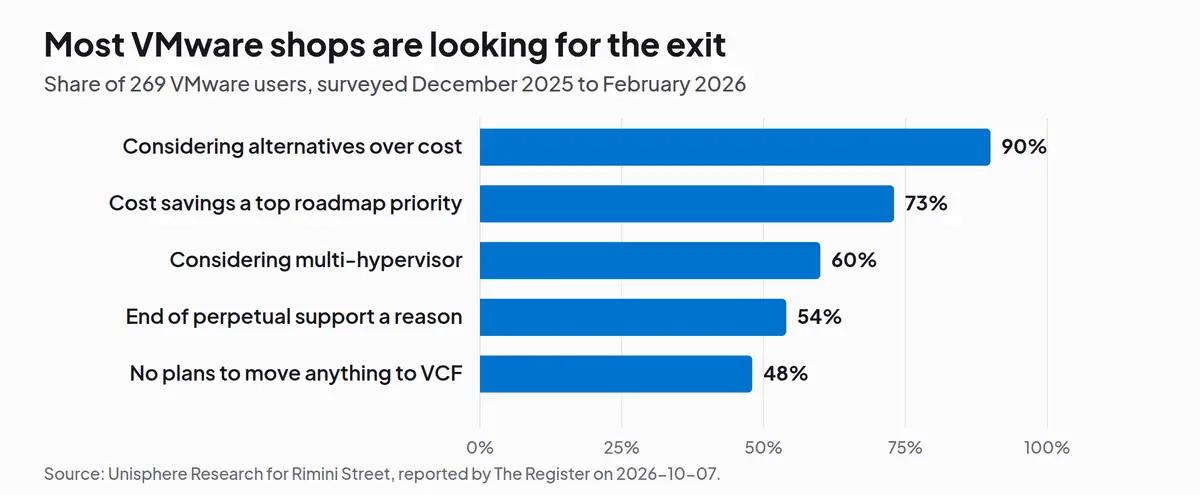
| Finding | Share |
|---|---|
| Considering alternatives because of licence costs | 90% |
| Cost savings are a top priority for the virtualization roadmap | 73% |
| Considering a multi-hypervisor strategy | 60% |
| End of perpetual licence support is a reason to evaluate others | 54% |
| No current plans to move any assets to VCF | 48% |
Two caveats: the survey was paid for by Rimini Street, a third-party support company that does well when people leave vendor support, and “considering” is not “migrated”. The biggest blockers respondents named were operational complexity (40%), managing several vendors (38%) and the skills their teams would need (37%). Gartner’s September 2026 prediction puts it more soberly: 55% of enterprises will start proofs of concept for alternatives by 2029, up from 25% in 2026.
Still, the direction is clear. Tesco’s move to Proxmox for its store virtualization, and its lawsuit against Broadcom (trial no earlier than November 2027), made that very public.
What it means for a home lab
This is where it hurts most, because the home lab was always VMware’s training pipeline.
- Free ESXi is back, but only just. ESXi 8.0 Update 3e can again be downloaded for free from the Broadcom support portal. It can’t be managed by vCenter, has no vMotion, DRS, HA or backup APIs, its API is read-only, VMs are limited to 8 vCPUs and hosts to two physical CPUs. It’s enough to learn the ESXi host client. It isn’t enough to learn vSphere.
- VMUG Advantage now needs a certification. Members who pass the VCP-VCF exam get three years of VCF licences for 128 cores, kept current by a short yearly refresher exam. Passing VCP-VVF gets vSphere Standard instead. The licences are for personal use only. That’s a real path for someone whose job is VMware, but it’s no longer the casual “pay a bit, lab everything” deal the old posts here described.
- The skills market moved. If fewer employers run vSphere, a vSphere lab is less useful practice. The question a lab should answer in 2026 isn’t “what does my employer run?” as much as “what will they run next?”
Where the lab went
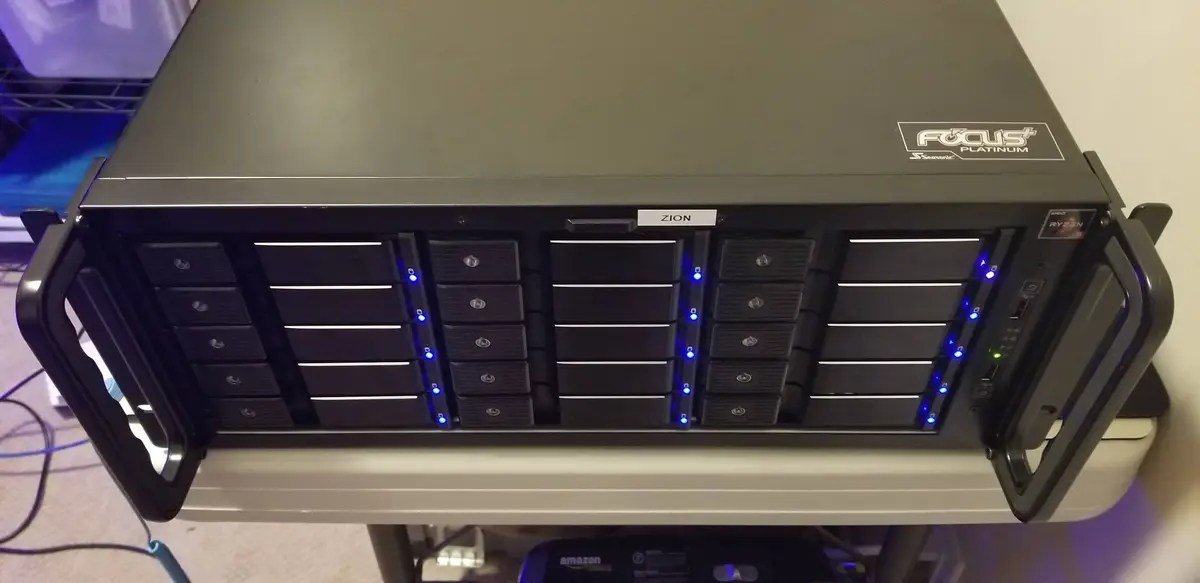
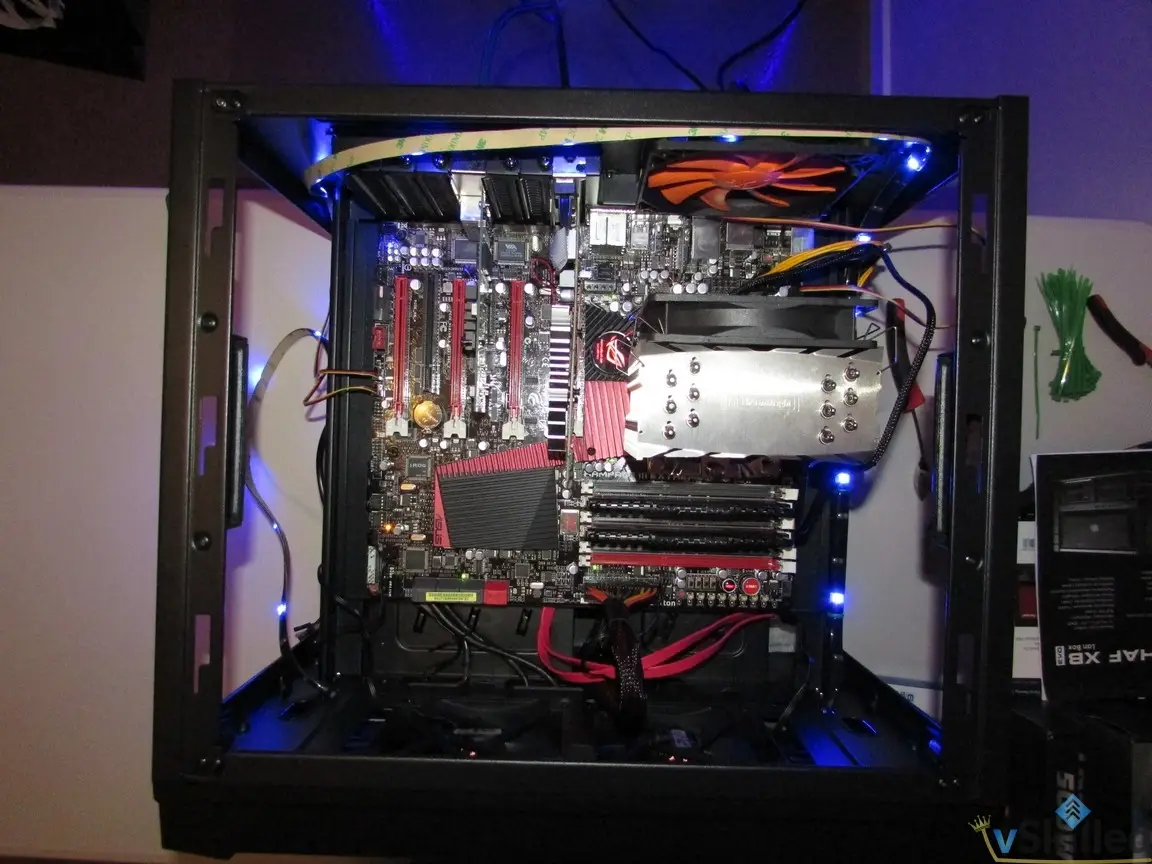
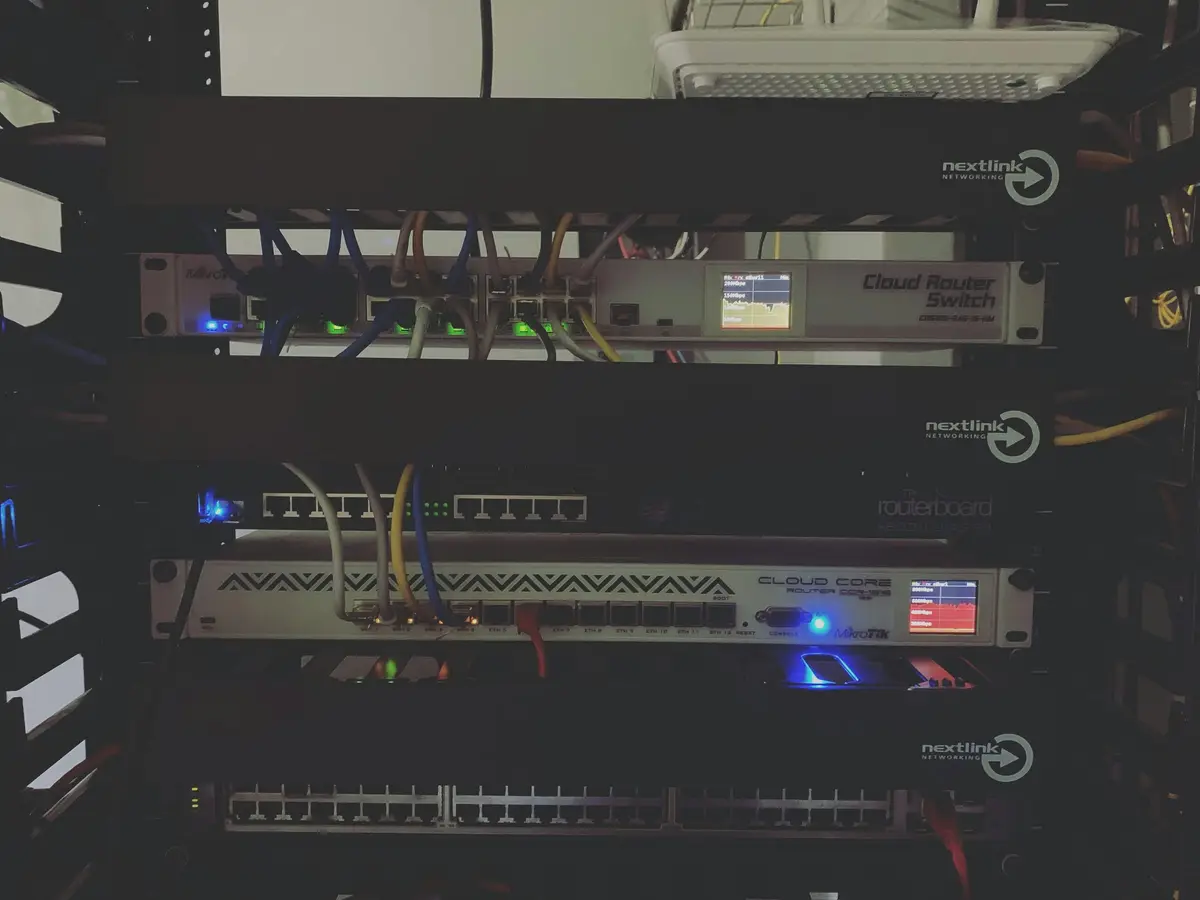
My own lab started drifting away before Broadcom arrived. By the 2020 upgrade storage had moved to Unraid, and VMs and containers followed because one box doing both used less power and less of my time. Today it’s Unraid servers running Docker containers and a handful of KVM virtual machines (Windows 11 included), plus an always-on mini PC for services that need to be up all the time. There is no ESXi left, and I don’t miss the licence key spreadsheet.
For anyone deciding now, this is how I’d think about the main options:
| Platform | Good fit for | Watch out for |
|---|---|---|
| Proxmox VE (9.2, May 2026) | The closest thing to “free vSphere”: clustering, HA, live migration, Ceph and ZFS, an ESXi import wizard | Subscription nag without a support plan; networking and storage are Linux skills, not wizards |
| Unraid | Mixed storage, containers and a few VMs on one box with mismatched drives | Not a cluster: each server stands alone; paid licence |
| Hyper-V and Windows Server | Windows shops, and practice for the job if your employer is heading to Hyper-V or Azure Local | Management tooling is spread across several consoles |
| XCP-ng with Xen Orchestra | A fully open source stack that still feels like vCenter | Smaller community than Proxmox |
| Nutanix CE | Practice for enterprises moving to Nutanix | Heavy hardware requirements for a lab |
| ESXi 8.0 free or VMUG Advantage | People whose job is still VMware | Limited free edition; certification required for the full stack |
If I were starting a lab from scratch today to learn enterprise virtualization, I’d pick Proxmox VE for the hypervisor and spend the saved licence money on a third node, because clustering, shared storage and failure testing are what a lab teaches best.
The takeaway
Broadcom hasn’t killed VMware. It has turned it into a product for large customers buying the whole stack, and it’s done that on purpose. If that’s you, VCF 9 is still a strong platform and the decision is about price. If it isn’t, the last three years have been a long nudge towards the door, and for home labs the door is wide open: the alternatives are better than they have ever been, and most of them are free.
Sources
Writing about virtualization, home lab, cloud, storage and gaming on vSkilled, started in 2014.